
Corporate AI investment reached $252.3 billion in 2024[1], and it is projected to continue growing through 2026. But have you ever felt that AI is creating more mess than momentum in your company? That's not just a feeling. Both Stanford and the comprehensive MIT report, "The GenAI Divide: State of AI in Business 2025," reveal that 95% of generative AI pilot programs fail to deliver a measurable impact on the profit and loss (P&L) statement[1][2].
The problem usually lies in organizations without a clear AI strategy. They invest in initiatives that sound promising but deliver little real return. How often do we hear,"We're saving three hours per week per employee with our latest solution"? But where do those hours actually go; and shouldn't they show up in a key KPI if the solution worked? If not, what's the point of investing in AI at all?
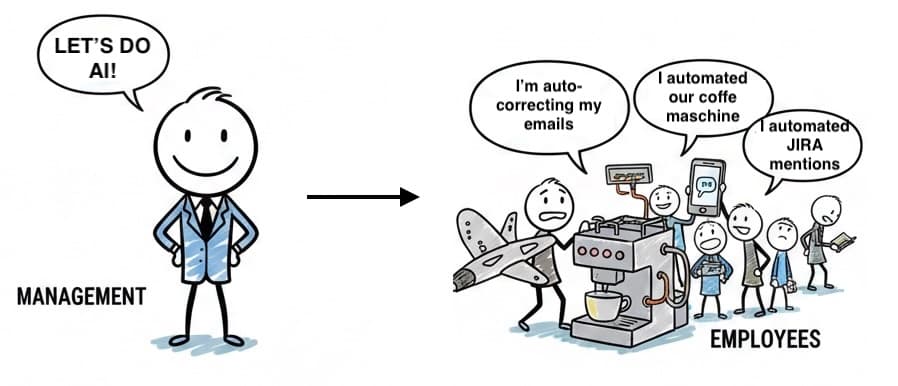
Generative AI is powerful. So why are so many investments failing despite the hype? The challenge is that organizations haven't figured out how to leverage it effectively. That's exactly where the smartest early movers gain a real advantage.
What Is a Good AI Strategy for Enterprises?
If you're reading this, you're likely not running a tech company trying to build the next foundation model. A good AI strategy for an enterprise is not about reinventing the wheel. It's about leveraging your existing assets and capabilities to strengthen what already makes your core product successful.Today, most AI initiatives in enterprises focus on generic functions like marketing, customer service, HR, or internal IT workflows[1].
These areas are important, but they rarely define your competitive advantage. Around 80% of companies that achieve sustained profitable growth do so by focusing on their core business, while diversification often dilutes focus and weakens performance[3][4]. Your job is not to create the latest model or automate standard processes that mature SaaS vendors already solve at scale. Your responsibility is to use AI where it directly improves your core product and moves meaningful KPIs; not where it simply optimizes tasks that every competitor can optimize in the same way.
If a vendor you rely on does not yet offer the features you need, consider switching rather than rebuilding their roadmap internally. Even when something looks like an “easy automation,” it often consumes more focus and resources than expected. A strong AI strategy keeps your organization focused on its differentiation and ensures that AI strengthens your product instead of pulling attention into side projects.
4 Steps to Ensure Your AI Improves Core Products
After years of seeing AI initiatives fail to deliver meaningful results, I've identified four key steps that help ensure your AI investments actually strengthen your core products and deliver real business impact. This matters because only a small portion of companies are truly capturing AI value — recent research shows that only about 5% of firms see measurable returns from AI investments at scale.
Focus AI on Core Product Features
Don't create AI initiatives for the sake of AI. Focus on your existing product backlog to identify features where AI can amplify value. No, your customers don't want yet another chatbot on the home page — or an “AI‑powered” widget that adds complexity without real benefit. Enterprises that embed AI deeply into core workflows and differentiators tend to capture far more value than those scattering effort across generic tools[1][5].
Calculate AI Costs vs Business Impact
Calculate the total cost of implementing and maintaining each AI initiative — including time, effort, and opportunity cost. Compare this against the expected business impact using structured ROI frameworks. Analysts warn that without this discipline, organizations end up with substantial spend and unclear visibility into financial return[6][7].
Track AI Performance and KPIs
Track each initiative against clearly defined KPIs tied to tangible outcomes like revenue growth, retention, operational efficiency, or product engagement. Research shows that many enterprises still lack robust ROI measurement systems[7], which contributes to underperforming projects.
Share AI Insights Across the Organization
Whether an initiative succeeds or fails, share the insights across your company so knowledge compounds. Firms that build organizational learning and feedback loops — not siloed pilot projects — accelerate their AI maturity and improve outcomes systematically.
Once you focus on these steps, you can start to see how AI can truly enhance your core product and drive meaningful business results. Companies that get this right will not only avoid wasted spend but also gain a significant competitive advantage in the AI era. At the same time, it's important to understand AI's limits — stay tuned for next week's post, where we'll dive deeper into how to maximize AI's strategic potential.This article is part of a series on AI strategy and implementation. We'll be posting weekly to share our thoughts on enterprise AI adoption.